“Circumnavigating Frampton’s Magellan: Charting a Self-Conscious Cinema.” La Furia Umana 48 (2026).
Prologue: Abstract Goals
Hollis Frampton’s “Statement of Plans for Magellan” sets out nine goals for his unfinished magnum opus. In this article, I will focus on the first and last goals and suggest some of the ways in which they might be conceptually intertwined and interconnected. Frampton first goal, which film theorist Michael Zryd refers to as “Metahistory,” is:
Rationalization of the history of film art. Resynthesis of the film tradition: “making film over as it should have been.” The making of a coherent body of work that shall systematically map the terrain of film art, together with its boundaries, according to poetic principles extrapolated or induced from film’s irrational natural history.1
Frampton’s final goal, which Zryd labels “Film Art as a Model for Human Consciousness,” is:
The notion of a hypothetical, totally inclusive work of film art as a model for human consciousness. I propose a work of art (not a scientific or philosophical theory) that shall touch upon a sufficient number of shores to cartoon my own affective world. We may assume that each thing implies the universe, whose most obvious trait is its complexity; on that principle, I conceive, distantly, of an art of cinema that might encode thought as compactly as the human genetic substance encodes our entire physical body.2
Frampton’s first goal seeks to construct a metahistory that reorganizes cinema’s past, treating it as an incomplete system of knowledge. His final goal proposes that cinema can encode thought as densely as DNA encodes life. By charting a metahistory, Frampton is envisioning an epistemological structure where cinema becomes both the repository and the mechanism of consciousness itself. Given that many philosophers believe that a necessary condition for consciousness is the embedding of strange loops within the system, this article will demonstrate some of the ways that Frampton encoded them into the structure of Magellan.
Act I: A Historian’s Job is Never Done
Gödel’s First Incompleteness Theorem
Any consistent formal system within which a certain amount of elementary arithmetic can be carried out is incomplete.
In the “Ox House Camel Rivermouth,” the preface to Circles of Confusion written in 1983, Frampton describes three ways in which “the system of words [language] remains incomplete.”3 The first sense is Barthes’ concept of the death of the author, where the act of reading dissolves the author’s authority, leaving the text as an autonomous field where meaning is generated by the reader, not dictated by its creator. The second sense, which is more important to our present goal, recasts Gödel’s Incompleteness Theorems within the realm of natural language. As Frampton explains:
The system of words cannot state the conditions of its own completion, since it remains unable to define the terms of a metalanguage to describe its own limits. Neither local nor global criteria yet obtain for deciding whether any given element in a discourse is to be taken as linguistic or metalinguistic. Thus our investigation of language remains, in its uttermost reaches, an expanding inventory of what Kurt Gödel called formally undecidable propositions.4
Frampton appropriates Gödel’s Incompleteness Theorems, extending their implications into the domain of language. It is worth restating that natural language is not a formal system and resists internal consistency. That is, it generates statements that evade categorization as strictly true or false. Yet this instability does not render such an inquiry unproductive, nor does it strip it of poetic or theoretical potential. Frampton identifies a final mode of linguistic incompleteness in the gap between words and the objects or ideas they signify. Writing, as a collection of symbols, remains sundered, yet connected to the objects the referent invokes. The genealogy of letters is traceable: even in their abstraction, modern letterforms descend from tangible entities—ox, house, camel, rivermouth—as his essay’s title suggests. These origins persist in vestigial form A, B, G, and M, retrospectively. Yet, if letters have become estranged from their material sources, the photograph and moving image, by contrast, circumvent that gap to some degree. They skip the middleman, so to speak.
If critic and theorist André Bazin’s “myth of total cinema” established the framework for a form of cinematic incompleteness, it was Frampton who proposed a model to formalize cinematic incompleteness by composing a cinematic metalanguage, or more precisely, a metahistory of cinema.5 By proposing that cinema is driven by an unending aspiration to fully capture reality, Bazin effectively outlines an ontology of absence: an art form predicated on the impossibility of its own completion. However, the incompleteness at stake for Frampton is not merely a historical or technological limitation but a fundamental epistemological condition. Frampton, channeling Gödel, envisions cinema not as an evolving medium progressing toward wholeness but as a system whose limitations are encoded within its own syntax.
Despite the fact that both believe that cinema as incomplete, Frampton and Bazin view this inherent limitation differently. Bazin’s myth suggests that there is a gap between moving images and its reproduction of reality, which can be seen as a variation on Frampton’s third form of linguistic incompleteness. Frampton, by contrast, aligns his paradigm of incompletion more closely to Gödel’s model, one of encoded self-referentiality: cinema encodes its own incompleteness from within. If Bazin dreams of a cinema that might one day arrive at an impossible totality, Frampton’s cinema does not pursue an ideal; instead, it fashions its own metahistory from fragmentary traces of its past and is premised on its fundamental incompleteness.
Even though Frampton insists that cinema constructs reality while Bazin believes that cinema’s primary function is to reflect it both grappled with cinema’s lack of an established history. As Bazin provocatively asserts: “Cinema has not yet been invented!6 Frampton, while taking a less extreme stance, nonetheless shares a related conviction: not that cinema itself has yet to be invented, but that its historical tradition remains to be established and that it is metahistorian’s duty to navigate this terrain. In “For a Metahistory of Film” Frampton states:
[The metahistorian] is occupied with inventing a tradition, that is, a coherent wieldy set of discrete monuments, meant to inseminate resonant consistency into the growing body of his art.
Such works may not exist, and then it is his duty to make them. Or they may exist already, somewhere outside the intentional precincts of the art (for instance, in the prehistory of cinematic art, before 1943). And then he must remake them.”7
Frampton’s metahistorical project, however, carries an inherent paradox. If such a cinematic history is to be constructed in a way that encode its own language, it risks becoming a double-edged sword, namely, the logical impasse Gödel uncovered in mathematics.
Gödel turned mathematics in on itself and revealed the limitations hidden within. He developed a method where numbers encode statements about themselves, making arithmetic self-referential. Within this system, he constructs the statement I am unprovable. If the system proves this statement, it contradicts itself. If it cannot, then the statement is true but unprovable within the system. This exposes a fundamental limitation: no sufficiently powerful mathematical system can be both complete and consistent. This is, in a nutshell, Gödel’s First Incompleteness Theorem. In a consistent system, there will always be formally undecidable propositions, statements that cannot be proven either true or false within the system.
So we arrive at an intriguing, if speculative, intersection. What might Gödel’s notion of formal undecidability reveal when applied not just to mathematics but to the realm of language itself? Or, more specifically, to the realm of cinema? The application of Gödel’s insights to cinema might not be obvious at first glance, yet it hints at an unbridgeable gap in the narrative frameworks that seek to encompass the totality of cinema. Let us start with the facts, those things that are known or proven to be true. In “For a Metahistory of Film,” Frampton begins with a brief metahistory of facts, that is, an understanding of the history of facts and their complex social, cultural, mythological, and aesthetic underpinnings.
In constructing a metahistory of facts, Frampton observes that there was a time when: “the world contained only a denumerable list of things. Anything could be considered simply as the intersection of a finite number of facts. Knowledge, then, was the sum of facts.”8 This statement is intentionally set in the past tense and this accumulation of facts is, as Frampton suggests, a Joycean “historical nightmare.”8 Frampton playfully describes a time before Gödel’s Incompleteness Theorems, before Georg Cantor’s Theory of Ordinals, before Werner Heisenberg’s Uncertainty Principle. Both “a time of utmost certainty” and an era of, “quite simply, too many facts.”8
As Frampton is well aware, even without the death of the author, literally or otherwise, the task of constructing a definitive, totalizing account of cinematic history is itself stymied by the limits of historical knowledge. This knowledge, no matter how well-intentioned, no matter how exhaustive, no matter how sharp the scalpel or splicer will inevitably encounter formally undecidable propositions or statements that cannot be shown to be facts or falsities. As such, there will be moments that resist interpretation, events that cannot be made to fit neatly into the overarching tradition that the historians attempt to construct. Things will have taken place that refuse to be assigned meaning, that thwart any attempt to place them within a coherent structure of history.
What these undecidable propositions reveal is not merely a failure of interpretation, but a fundamental truth about knowledge (and cinema) itself: its capacity to elude the grasp of totalizing narratives. These moments are not anomalies to be accounted for; they are essential to the very nature of language and cinema. They echo the incompleteness encountered in Gödel’s work. And so the omniscient historian’s project, as with any attempt to construct a totalizing history of cinema, is destined to failure. The closer one gets to completing the task, the more facts collected, the more apparent the gaps become. The project becomes a confrontation with its own limits, a confrontation that cannot be reconciled within the very system it seeks to understand.
Act II: Egress Mistaken for Terminus
Gödel’s Second Incompleteness Theorem
For any consistent system within which a certain amount of elementary arithmetic can be carried out, the consistency of system cannot be proved in system itself.
If Gödel’s First Incompleteness Theorem problematized what can be known within a formal system, the Second Incompleteness Theorem suggests that the system cannot fully know itself. A system cannot prove its own consistency from within itself. This claim single handedly dismantles one of central goals of early twentieth century mathematics, namely, to establish a finite set of axioms that is both compete and consistent. The consequences extend beyond formal logic, affecting computation and philosophy, revealing that even the most rigorous structures contain unavoidable gaps. Mathematics still functions, but its boundaries are now clear: any sufficiently powerful mathematical system cannot completely know itself.
This is where the metahistorian enters. It is there job to reimagine the ways in which facts cohere into a narrative or even a tradition. If the historian amasses fragments in the pursuit of an ever-expanding, never-complete system of knowledge, the metahistorian performs a subtler alchemy: transforming these fragments into a work of art. In cinema, the metahistorian gestures toward a medium that turns upon itself, twisting in recursive loops of myth and documentation, fiction and historiography. But have the cinema historians and theorists performed their job? Have the historians collected enough facts for the metahistorian to perform their alchemy? Are the foundations of the medium sufficiently developed to sustain the weight of self exploration?
In the early twentieth century, mathematics was a discipline in crisis. Alfred North Whitehead and Bertrand Russell’s Principia Mathematica emerged from a Victorian faith in order to purge ambiguity and impose a formalist structure on truth itself. In particular, they were attempting to overcome Russell’s Paradox: The set of all sets that are not members of themselves.9 Despite bearing Russell’s name, the paradox was discovered independently by other mathematicians, many of whom thought it posed an insurmountable problem since it demonstrated that set theory, the foundations of modern mathematics, might not be consistent. Formulating the foundations is a significant part of modern mathematics and was crucial for developing a formal language of mathematics, the underlying structure of mathematics itself. Similarly, in 1979 Frampton asks why no-one has developed a Principia Cinematica:
After a century, nevertheless, it is still true that no one knows even how to begin to write the sort of thing that film through its affiliation with the sciences might expect of itself, that is a Principia Cinematica, presumably in three fat volumes entitled, in order: I. Preliminary Definitions; II. Principles of Sequence; III. Principles of Simultaneity. The wish for such a thing is somewhat like the wish of a certain aphorist who said—I believe the last of his aphorisms, or at least the last that I have read— that he would like to know the name of the last book that will ever be published.10
A metatheory requires a scaffolding from which to extend. In the case of mathematics, it is the taut, invisible wires that bind its underlying foundations. This is similar to what Frampton seeks in the Principia Cinematica since it is impossible to speak about a system without first understanding its inner workings.
Frampton might have been asking for too much by demanding that the foundations of cinema align directly with those of mathematics. In 1979, cinema was still relatively young (and an enfant terrible in the arts), yet there had been a few attempts to formalize it. For instance, Eisenstein’s Film Form, while not exactly three fat volumes, contained essays titled “Film Language,” “Methods of Montage,” “The Structure of Film,” and “The Cinemagraphic Principle” and Metz’s Film Language: A Semiotics of the Cinema had already been translated into English. But as Zryd observes, “film lacked the legacy of theorization of its ontology and form that literature (e.g., Plato) or the visual arts (e.g., da Vinci) had within the Western tradition” and experimental and avant-garde cinema was just beginning to enter academia. Furthermore, it is important to remember the stature of early cinema in this period. Zryd suggests, “Frampton and other experimental filmmakers anticipated by more than a decade the mainstream academic interest in the history of protocinema and early film.”11 In other words, Frampton was, again, venturing out into fairly uncharted territories, at the vanguard.
If Gödel revealed that arithmetic can speak about itself through its own language, Frampton sees cinema doing the same: examining its own tradition through recursive gestures, through its persistent invocation of its past. Metahistorians, then, do not merely chronicle. They are artists that reconstruct, reassemble, reinvent, and narrativize. As filmmakers, they splice and collate notions, suspending them in poetic articulations of thought. As artists, they inscribe themselves into the emulsion.12 Their task is to articulate a history in its incompleteness by finding meaning from poetic selection. The infinite cinema, then, is a methodological imperative. If the footage exists, use it. If it does not, create it. If it is lost, re-create it.
Act III: The Infinite Cinema
The Axiom of Choice
For any set X of nonempty sets, there exists a choice function f that is defined on X and maps each set of X to an element of that set.
Frampton’s notion of the infinite cinema operates simultaneously as a metaphor and a method. It is an index of the encyclopedic knowledge, a site of mythopoesis and an expansive epistemological system, a form of consciousness. Magellan is not a dramatization of the navigator’s passage but rather an historiographic maneuver, a charting of cinema’s totality, which is, as previously noted, an impossible itinerary. Here, Frampton positions himself not as a chronicler of the already-known but as a metahistorian, probing the limits of a system whose horizon, even in the asymptotic pursuit of completion, remains constitutively deferred. The system can be read as cinema, or knowledge, or as consciousness itself, but, perhaps more importantly, Frampton sees all of these systems as interrelated.
In “For a Metahistory of Film,” Frampton describes the infinite cinema as follows:
A polymorphous camera has always turned, and will turn forever, its lens focussed upon all the surfaces of the world. Before the invention of still photography, the frames of the infinite cinema were blank, black leader; then a few images began to appear upon the endless ribbon of film. Since the birth of the photographic cinema, all the frames are filled with images.
There is nothing in the structural logic of cinema filmstrip that precludes sequestering any single image. A still photograph is simply an isolated frame taken out of the infinite cinema.13
From Frampton’s formulation, two conclusions emerge: first, Frampton views photography as a subset of cinema; second, prior to the advent of the photographic process, cinema existed as pure potentiality, a yet to be inscribed medium.
In order to illuminate how Frampton’s conceptual infinite cinema might be formalized as a construct rather than merely described as a metaphor, let us consider one way to construct an arbitrary infinite film using the Axiom of Choice. Consider the set of natural numbers, ℕ* = {1, 2, 3, …}. For each element, select a shot from the set of all possible cinematic images. By applying the Axiom of Choice to this family of sets, one thereby constructs an infinite film. A similar, albeit more intricate, procedure could be used to generate the infinite cinema, though I leave the exact details as an exercise for the reader.14
It is also worth noting that the Axiom of Choice provides a theoretical framework for eliminating what Frampton designates as “nominally subjective, ‘thumbprint’ procedures”—another goal of Magellan.15 The Axiom of Choice, with its abstract choice function, allows for arbitrary selections to be made, thus becoming an operative principle within Frampton’s methodological framework: a means for structuring all potential filmic images.
Magellan offers itself as a conceptual model for a filmic Library of Babel, at once more poignant and more perilous than its textual precursor. If Borges’s hexagonal galleries house the sum of all language, Frampton’s Magellan dreams of a cinema composed of every frame, an archive of relentless variation: “the infinite film contains an infinity of endless passages wherein no frame resembles any other in the slightest degree, and a further infinity of passages wherein successive frames are as nearly identical as intelligence can make them.”16 This infinite film, the universe transformed into image, would require an infinite vault. “If we are indeed doomed to the comically convergent task of dismantling the universe and fabricating from its stuff an artifice called The Universe, it is reasonable to suppose that such an artifact will resemble the vaults of an endless film archive built to house, in eternal cold storage, the infinite film.”16
This eternal cold storage can be imagined as the media collection at the Library of Babel. Curator and scholar Bruce Jenkins, in “The Red and The Green,” notes how sections of Frampton’s Magellan operate as a retrieval system, an engine of aesthetic citation capable of summoning fragments from the infinite: “Frampton makes frequent use of such filmic quotations and aesthetic homages throughout Magellan—simulating a sort of high-tech retrieval system able to key up disparate fragments of visual discourse stored on the reels of the ‘infinite film.’”17 To Frampton, the films that made up the infinite cinema weren’t just classics or studio productions, they also contained the vernacular and the banal. He warns:
Of the whole corpus [the material component of the infinite cinema] the likes of [Battleship] Potemkin make up a numbingly small fraction. The balance includes instructional films, sing-alongs, endoscopic cinematography, and much, much more. The historian dares neither select nor ignore, for if he does, the treasure will surely escape him.18
In particular, the 16mm films available from the Library of Congress Paper Print Collection where of special importance for Frampton’s project.
With the advent of the digital and with the totalizing sweep of database logic, this system no longer requires conceptualization. It seems the cold storage has transformed into a hub of servers with nearly everything available at the click of button. After Frampton passed away, it is rumoured that Clio visited Godard and whispered: “Portions of the infinite cinema have now been digitally encoded for your convenience.”19
Act IV: Strange Loops and Cinematic Consciousness
The Möbius Strip
Frampton further believes that both language and images have the potential to “constitute the system of consciousness,” where each resolves “the contradictions inherent in the other.”20 To Frampton, all of knowledge, which can be seen as a collection of facts, the infinite cinema, a universe of endless possibilities, serves as a model of human consciousness. In I Am a Strange Loop, Douglas Hofstadter defines strange loops as:
not a physical circuit but an abstract loop in which, in the series of stages that constitute the cycling-around, there is a shift from one level of abstraction (or structure) to another, which feels like an upwards movement in a hierarchy, and yet somehow the successive “upward” shifts turn out to give rise to a closed cycle. That is, despite one’s sense of departing ever further from one’s origin, one winds up, to one’s shock, exactly where one had started out. In short, a strange loop is a paradoxical level-crossing feedback loop.21
In fact we have already dealt with one example of a strange loop in this article, namely, the self-referential language used in construction of the proof of Gödel’s incompleteness theorems. Hofstadter argues that strange loops—self-referential, cyclical structures—might be crucial for consciousness, though this remains a philosophical and scientific exploration rather than a settled fact.
As Brian Henderson argues in Magellan, “nonlinearity and palindromicity are built into the work’s very globalism; they operate in the Magellan metaphor itself, for to circumnavigate the world is to encounter the reversibility and inversion of all things.”22 One of the films in Magellan that explicitly references a palindromic structure is Palindrome, a film Henderson concisely describes some of the difficulties involved with constructing a filmic palindrome.23 He suggests:
A filmic palindrome is far more difficult than making one of words or numerals or a series of headings; while words, numerals, and headings need not be legible upside down to be palindromes, a film must be so. Assuming the requisite double sprocket holes on a given print, Palindrome would maintain its identity shown backwards—not only in reverse order but upside down. In principle, at least, the film need not ever be rewound. (Palindrome’s parameters are elucidated in various Frampton interviews and other sources.)24
In order to determine the palindromic nature of Palindrome, let use examine the first and the last image of Palindrome (excluding the title cards).
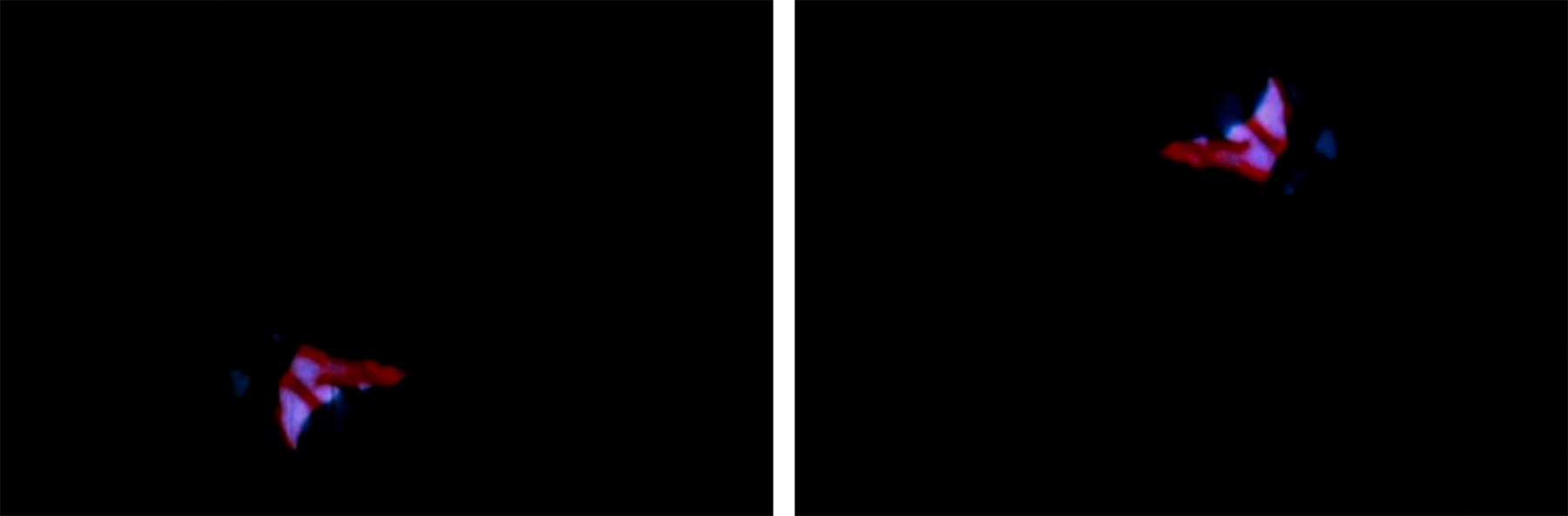
The last image is simply the first image rotated about the centre of the frame by 180 degrees, which demonstrates that Henderson’s observation about the necessity of double sprocket holes is indeed correct, since the 16mm film would need to be reversed and flipped on playback. Moreover, we can see the film does not mimic the literary palindromic form where the first letter is identical to the last, the second letter is identical to the second last and so on. Moreover, Frampton’s Palindrome is not a perfect filmic palindrome and would not actually be identical shown both forwards and backward for reasons that, I feel, ultimately contribute to the aesthetic success of the work.
One of the main reasons the film is not a perfect filmic palindrome is that different variations of the same footage are used. Frampton explains:
Forty phrases of twenty-four single frames were generated by animation. Then a set of variations was made at the lab which produced the following: an image of the original roll (colour, single layer); a continuous tone black & white version; a black and white negative; and a colour negative. Other sets were produced by printing the original roll superimposed on itself, so that the blocks of image fall on each other, but so that we see images first to last on one level, last to first on the other. A colour positive, colour negative, black-and-white positive, and black-and-white negative were made that way. Then came a set made from the black and white; on the forward pass, the original was printed through a yellow filter, and on the reverse pass, through a blue; and others were done the same way except with magenta and green filters. Those generated rolls were intercut with each other, interwoven around the centre point.25
Frampton, ever the meticulous architect of cinema’s mechanics, constructs Palindrome through recursive variations. To achieve a filmic palindrome in its purest form, each frame from the first half must return, rotated about the centre of the frame by 180 degrees, in reverse order in the second half of the film. Yet, in Palindrome, these echoes are not always exact; they flicker in negative, dissolve into superimpositions, shifting yet still bound to the structure’s logic. Just as a literary palindrome bends to accommodate punctuation and spacing, Frampton’s filmic palindrome allows for a similar plasticity.
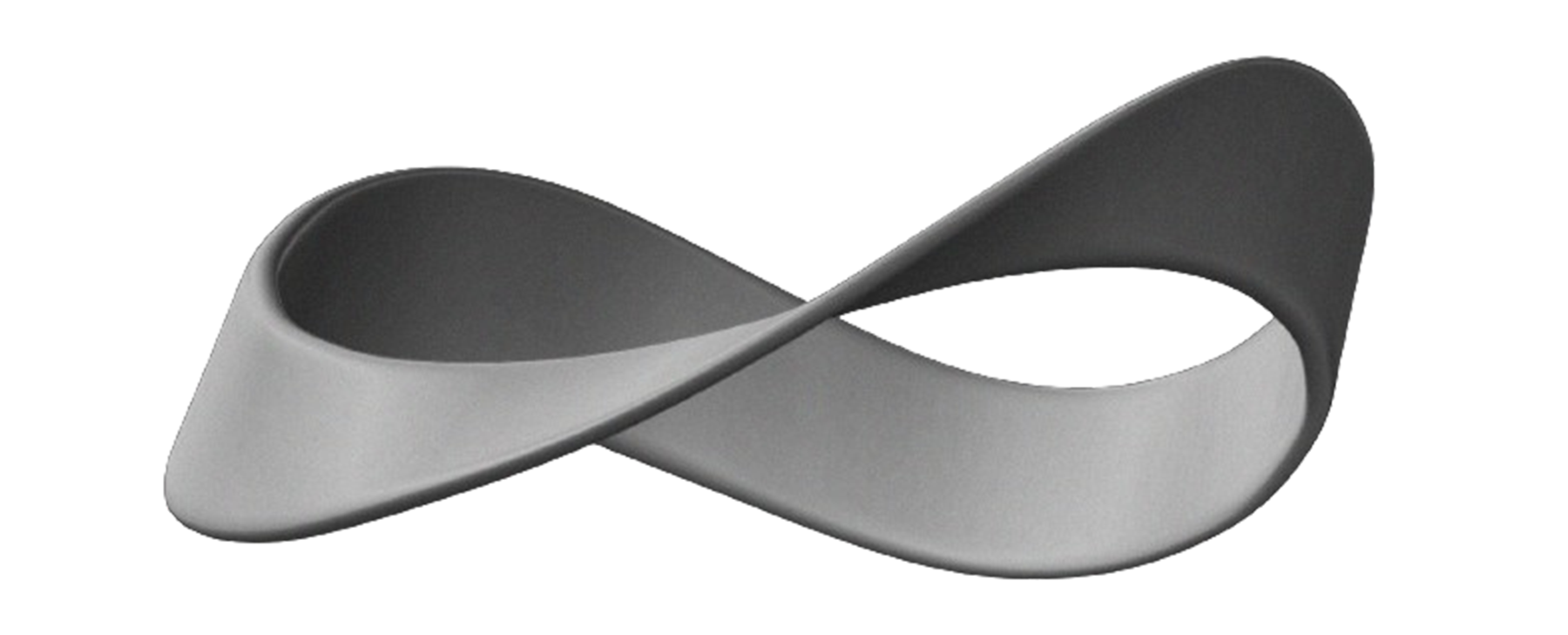
Looping Palindrome on a double-sprocketed film strip produces an object with a single surface, namely, a Möbius strip. Here, Frampton encodes a strange loop into Magellan, an ouroboros of image and structure. In doing so, he gestures toward something beyond mere mechanics: a feedback system of recurrence and difference, a pattern that Hofstadter argues is essential for consciousness itself. To think through Magellan is to enter a strange loop where cinema, in turning upon itself, reveals the paradox of its own apprehension. A Möbius strip unfurls: perception becomes knowledge, and the screen, both membrane and mirror, inscribes its own passage through time. Cinema sees itself through its own history. The film unfolds endlessly as it interrogates its own articulation, exposing cinema’s horizon as an ever-receding asymptote, a form at once totalizing and perennially incomplete.
- Michael Zryd, Hollis Frampton: Navigating the Infinite Cinema (Columbia University Press, 2022), 54.
Hollis Frampton, “Statement of Plans for Magellan” [1978], On the Camera Arts and Consecutive Matters: The Writings of Hollis Frampton, ed. Bruce Jenkins (MIT Press, 2009), 226. [↩] - Zryd, Hollis Frampton, 70.
Frampton, “Statement of Plans for Magellan”, 228. [↩] - Hollis Frampton, “Ox House Camel Rivermouth: a preface,” Circles of Confusion: Film, Photography, Video; Texts 1968-1980 (Visual Studies Workshop Press, 1983), 8. [↩]
- Frampton, “Ox House Camel Rivermouth,” 9. [↩]
- André Bazin, “The Myth of Total Cinema,” What is Cinema?, ed. and trans. by Hugh Gray (University of California Press, 1967). [↩]
- Bazin, “The Myth of Total Cinema,” 21. Exclamation in original. [↩]
- Frampton, “For a Metahistory of Film: Commonplace Notes and Hypotheses” [1971], On the Camera Arts and Consecutive Matters: The Writings of Hollis Frampton, 136. [↩]
- Frampton, “For a Metahistory of Film,” 132. [↩] [↩] [↩]
- If it is a member of itself, it is not a member of itself. If it is not a member of itself, it is a member of itself. [↩]
- Frampton, “The Invention without a Future” [1979], On the Camera Arts and Consecutive Matters: The Writings of Hollis Frampton, 181. [↩]
- Zryd, Hollis Frampton, 55. [↩]
- Frampton, “Statement of Plans for Magellan”, 227. This is goal five of Magellan. Zryd labels this goal as “Autobiography,” see:
Zryd, Hollis Frampton, 63. [↩] - Frampton, “For a Metahistory of Film,” 134. [↩]
- For more see my article, “Frampton’s Demon: A Mathematical Interpretation of Hollis Frampton’s Zorns Lemma.” Leonardo 49, no. 2 (April 2016), 156-161.
In this article, I consider multiple mathematically equivalent formulations of Zorn’s Lemma, including those Frampton himself explicitly engaged. The article proposes a reading of the second section of Zorns Lemma as a visual demonstration of the Axiom of Choice, a foundational principle mathematically equivalent to Zorn’s Lemma (despite its designation, the latter is not a lemma but an axiom). This is not to suggest that Frampton intended his film as a rigorous mathematical treatise, nor that such a reading is necessitated by the work itself. Rather, it is to acknowledge that Frampton structured the film in such a way that this interpretation remains available—if not actively solicited. In my reading, Frampton functions as the choice function within the system of the film—rendering the explicit invocation of the axiom unnecessary, nevertheless, the film a visual demonstration of the Axiom of Choice. [↩] - This is goal three of Magellan. Frampton, “Statement of Plans for Magellan”, 226.
Zryd labels this goal as “Procedural Parameters (Serial Music).” Zryd, Hollis Frampton, 58. [↩] - Frampton, “For a Metahistory of Film,” 137. [↩] [↩]
- Bruce Jenkins, “The Red and The Green,” October 32 (Spring 1985), 87. [↩]
- Frampton, “For a Metahistory of Film,” 136. [↩]
- “As [Michael] Witt and others have surmised, Frampton’s work is fundamental for the thinking-through required by Godard’s Histoire(s) [du cinéma], given his fidelity to film and Godard’s transition to video.” For an examination of the influence of Frampton on Godard’s Histoire(s) see:
Giles Fielke and Ivan Cerecina, “Metahistory on Video: Hollis Frampton in the Histoire(s),” Senses of Cinema 100 (January 2022). [↩] - Frampton, “Ox House Camel Rivermouth,” 10. [↩]
- Douglas Hofstadter, I am a Strange Loop (Basic Books, 2007), 101-2. [↩]
- Brian Henderson, “Propositions for the Exploration of Frampton’s Magellan” October 32 (Spring 1985). 140. [↩]
- Of course, this wasn’t the only place Frampton implemented the palindromic structure. As Zryd argues, Magellan: At the Gates of Death, “has two parts, The Red Gate and the Green Gate, each with twelve roughly five-minute segments, each of which is structured in palindromic fashion, its beginning mirroring its end. This means that each segment could be projected forward or backward, and indeed each segment has a place in the Magellan Calendar with one of two notations: to be screened right side up and forward (RI) or upside down and backward, or obverse (O).” [↩]
- Henderson, “Propositions for the Exploration of Frampton’s Magellan,” 137. I have taken this one step further and suggest that there are different types of filmic palindromes. For instance, the palindromic structure of Bruce Conner’s BREAKAWAY which follows the literary structure is very different from the structure of Palindrome which is more of a filmic palindrome. See:
Clint Enns, “A Brief Analysis of Hollis Frampton’s Palindrome; and how to construct five types of filmic palindromes.” Millennium Film Journal 63 (Spring 2016), 65-70. [↩] - Frampton in Scott MacDonald, A Critical Cinema: Interviews with Independent Filmmakers (Berkeley: University of California Press, 1988), 45. [↩]