“Marc-Antoine K Phaneuf,” Border Crossings Magazine 170 (March 2026): 121-2.
Imagine a Canadian Heritage Moment. It might read like this:
The origins of hockey can be traced back to the Mi’kmaq people, whose early variations of the game helped shape what would eventually become Canada’s national sport. The modern form of hockey emerged in Montreal in 1875, and the game’s institutional foundations solidified there as well. The National Hockey League was organized at the Windsor Hotel on November 26, 1917, following the suspension of the National Hockey Association. Today, and with little controversy, hockey stands as the most popular sport in Canada. All of this is to say that the game’s deep entanglement with Indigenous traditions, Québécois identity and broader Canadian culture makes it a fertile ground for artists working from our home on Native land to critically engage with.
At least that’s one possible history.
Without reference points like graphic designer Jonato Dalayoan’s Winnipeg Jets custom jersey for the fourth annual Filipino Heritage Night, or Lucas Morneau’s crocheted uniforms for the imagined Queer Newfoundland Hockey League—populated by teams such as the Fogo Island Fag Hags and the Bonavista Buggers—the aesthetic kinship between hockey and the arts may remain invisible. Taken together, however, these examples reveal just how deeply hockey operates as an aesthetic and cultural touchstone, a premise that underpins Marc-Antoine K Phaneuf’s “Hockey – Beauté fanatique” (“Hockey – Fanatic Beauty”). In this exhibition, the artist probes questions of Canadian identity, cultural memory and the aesthetics of the everyday by turning his attention to a cornerstone of Canadian popular culture. Through this lens, Phaneuf unpacks how national myths are formed, how they circulate and how the mundane objects surrounding the sport accrue symbolic weight.
In his ongoing collage series “Goalies on Art,” (2015–present), Phaneuf addresses such skepticism directly by placing goaltenders in direct visual dialogue with iconic artworks, teasing out unexpected formal affinities. By drawing parallels between the colour palettes, rhythms and compositional structures of commercial hockey photography and those of fine art, Phaneuf reveals how the visual language of sport and the language of art are not as distant from one another as they might initially appear.
For instance, in Tony Esposito on Gerhard Richter (2025), a closely cropped, instantly recognizable image of Esposito is superimposed onto an equally recognizable Richter painting—identified in the on-page caption as Confus (1986). The red, black and yellow of Esposito’s Chicago Blackhawks jersey align strikingly with the hues in the painting, achieving the kind of harmonious visual pairing collage artists informally refer to as “matchy-matchy.”
Not surprisingly, hockey cards follow their own recognizable visual conventions—a fact Phaneuf makes sharply evident in his “Goalie x Goalie” series (2015). Each work collages two hockey cards together using only a single straight cut, yet even this minimal intervention exposes how standardized poses, framing and design elements can be seamlessly interchanged. The result not only plays with the format as a form of visual language but also reveals it as a system as codified as any artistic tradition, complete with its own criteria for what counts as aesthetic “excellence.”
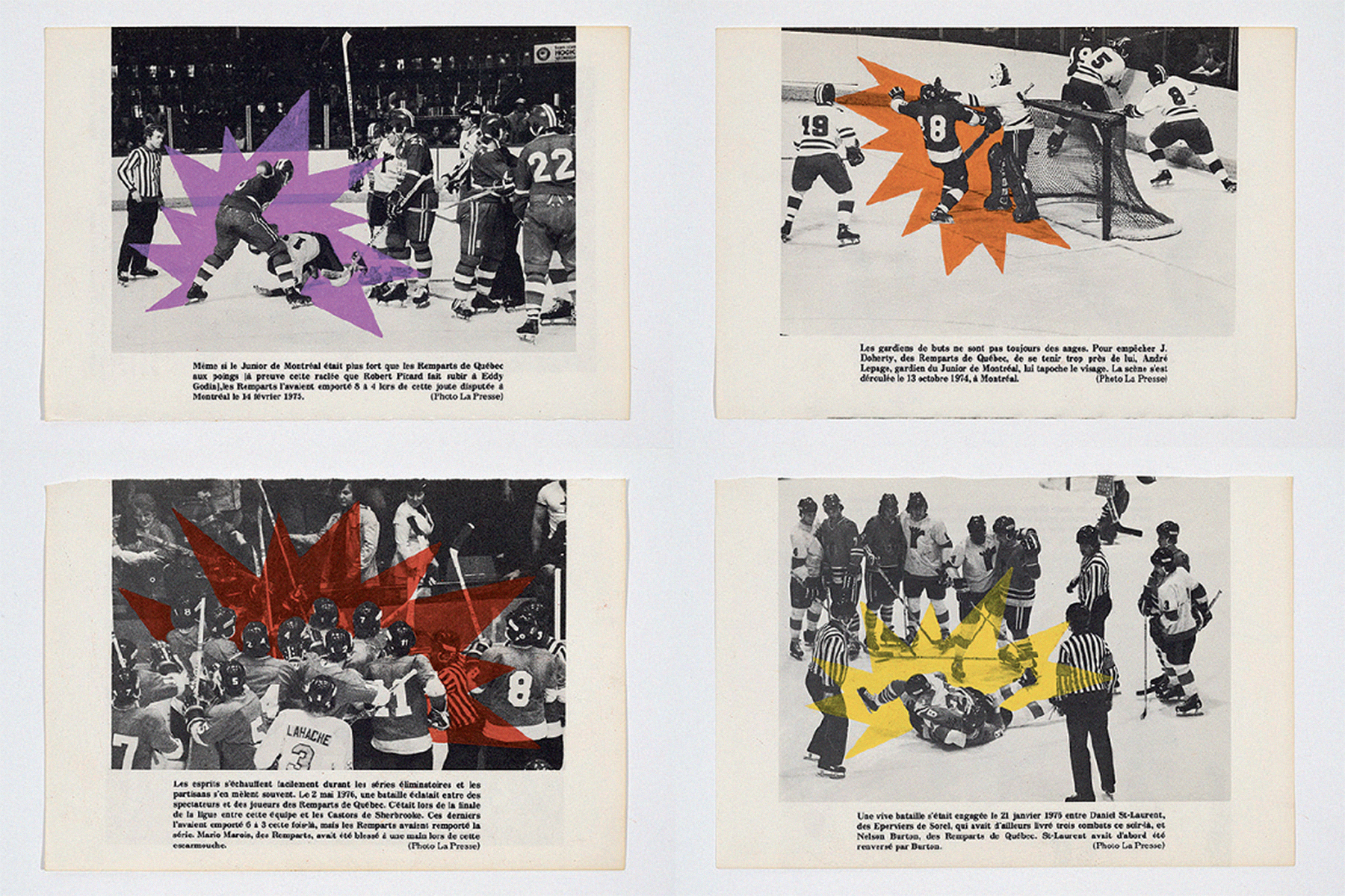
One of the more controversial aspects of hockey has long been linked to the sport’s tendency toward violence. In “Violence au hockey” (“Violence in Hockey”, 2014), Phaneuf undercuts this aggression by surrounding fight scenes with jagged, comic-book-style bubbles rendered in pencil crayon. Yet this act of visual softening simultaneously draws attention to the fact that such violence is normalized within the sport. This work would make a nice pairing with Brett Kashmere’s Valery’s Ankle (2006). This video essay examines Bobby Clarke’s deliberate breaking of Soviet star Valery Kharlamov’s ankle during the 1972 Summit Series. Kashmere suggests that this celebrated act of brutality reveals something deeper about the forms of violence embedded within the Canadian subconscious. How does a nation known for being courteous and polite come to celebrate such a deplorable and unsportsmanlike act?
Phaneuf’s artworks frequently draw on vernacular culture, repurposing images sourced online. Les Nordiques ne reviendront pas (The Nordiques Will Not Be Returning, 2025), is composed of 435 photographs of memorabilia from the former Quebec City hockey team, all culled from Facebook Marketplace listings. Much like Paul Butler’s Winnipeg Without the Jets (2005), a vintage Winnipeg Jets logo with the jet removed, the work makes an absence visible: the cultural void left in a city that has lost both a beloved symbol and a key component of its civic identity. And while the Jets ultimately returned to Winnipeg, Phaneuf reminds us that a similar resurrection of the Nordiques is, in all likelihood, not in the cards for Quebec City.
This vast collection reframes each seller as an inadvertent archivist and cultural producer, contributing to a distributed, crowd-sourced record of collective memory. Facebook Marketplace plays a multi-faceted role in Québécois culture, operating simultaneously as marketplace, archive and chaotic staging ground for the annual July 1st roommate swap. It has even functioned as an art venue, hosting the “exhibitions” of visual artist Antoine Laroque through his project “Galeriste Québécois.”
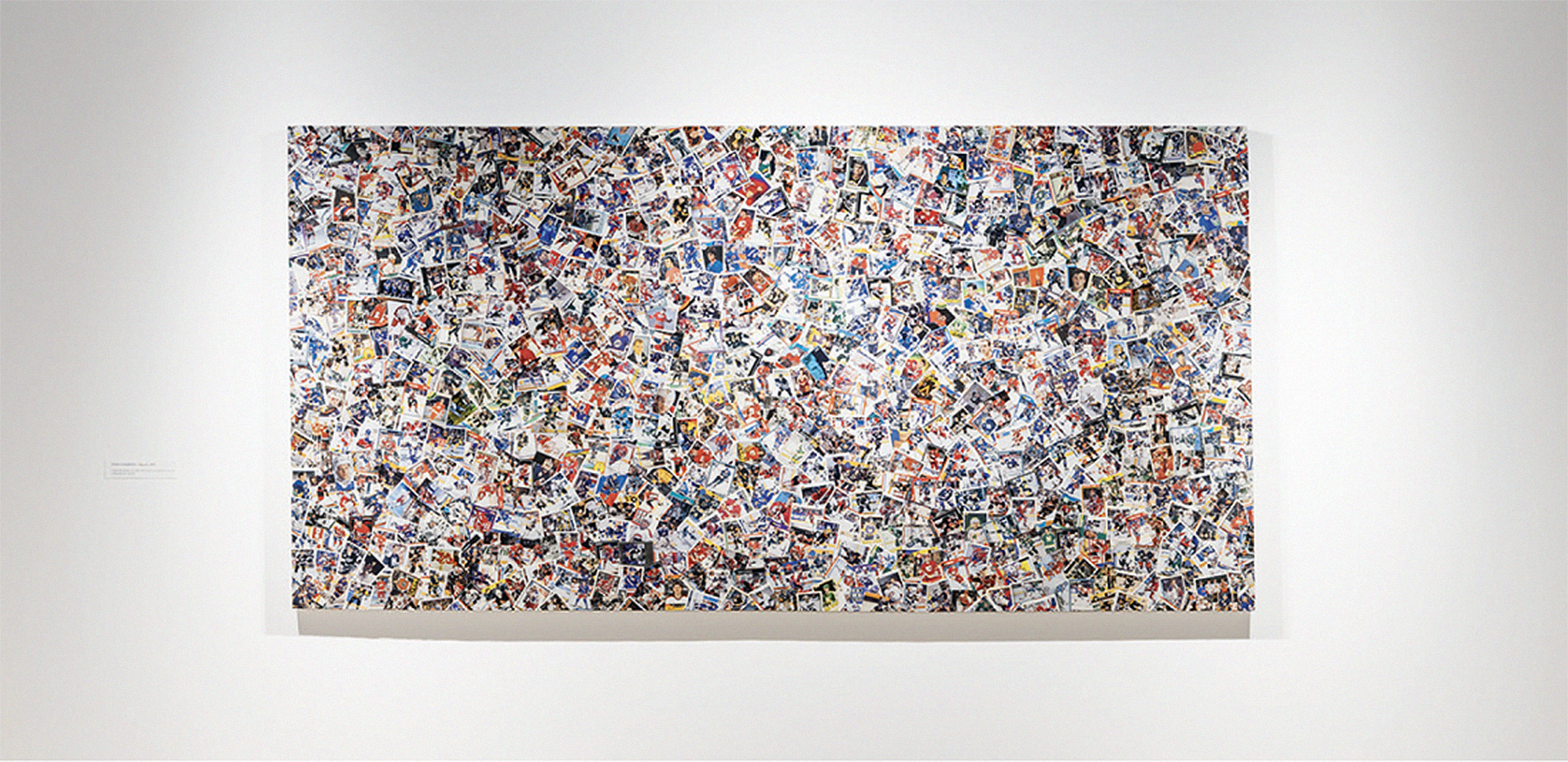
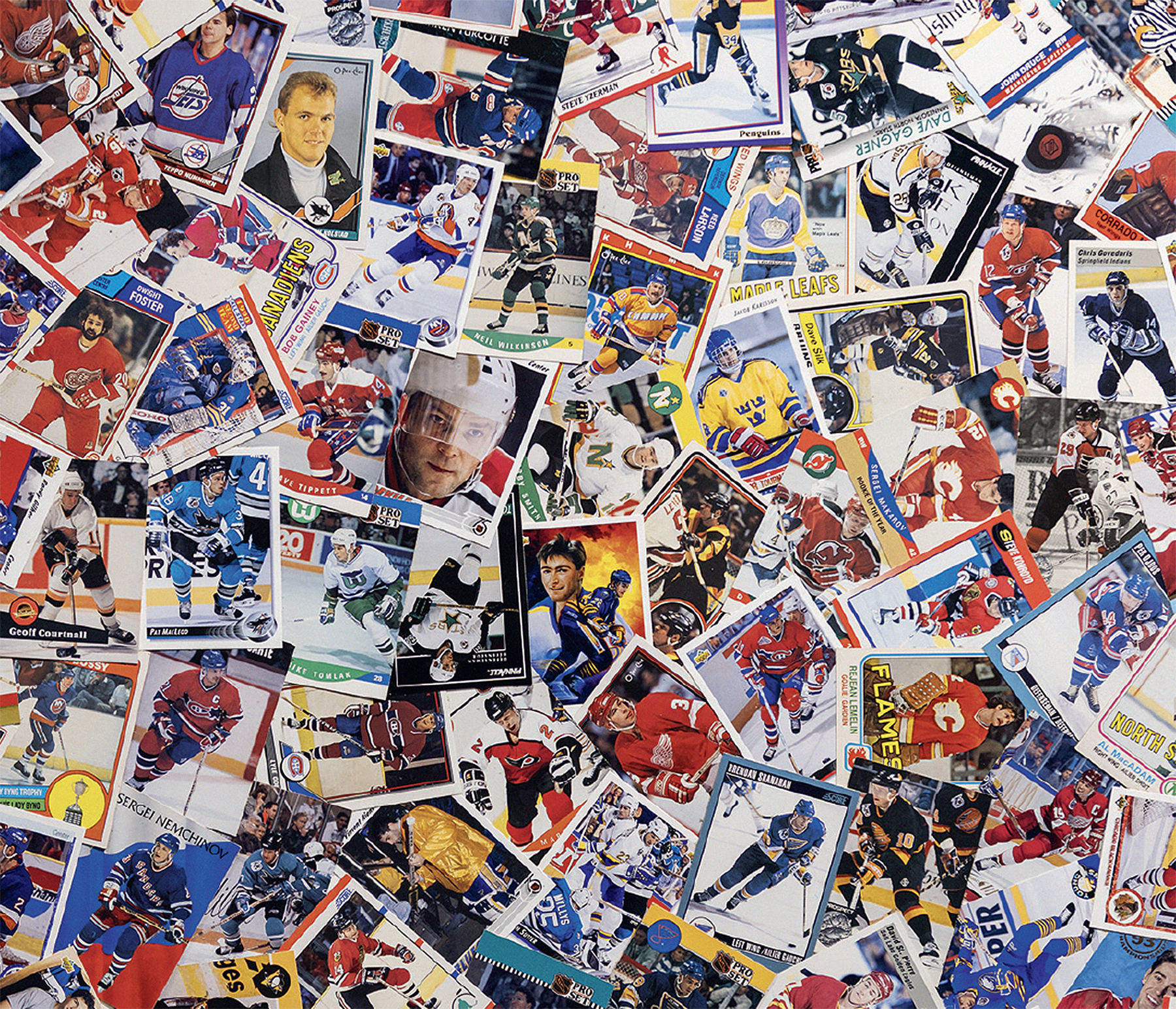
While visiting the “Beauté fanatique,” a preteen was standing in front of what might be considered the centrepiece of the show, Peinture canadienne – ébauch (Canadian Painting – Sketch, 2017), one of an ongoing series of installations composed of hockey cards arranged to echo the patterns and gestures of Canadian abstract painting from the 1940s and 1950s, in particular, those of Québécois painter Jean Paul Riopelle. The preteen studied the cards the way one might scrutinize the brushwork of a painting, all while reciting player stats and proudly identifying the cards in his own collection. I asked him if he liked Riopelle. He responded in all sincerity, “I’ve never heard of him. What team did he play for?”
What may appear as a cultural gap is, in fact, a reminder that art demands, and rewards, multiple forms of literacy. It shows how new, unexpected modes of engagement emerge when popular culture enters the gallery and is taken seriously as an aesthetic form. This is one of the exhibition’s greatest strengths: its ability to meet viewers where they are, to draw in those who may feel far more at home in the arena than in the white cube.