“The Artist’s Voice.” Millennium Film Journal 83 (2026): 62-63.
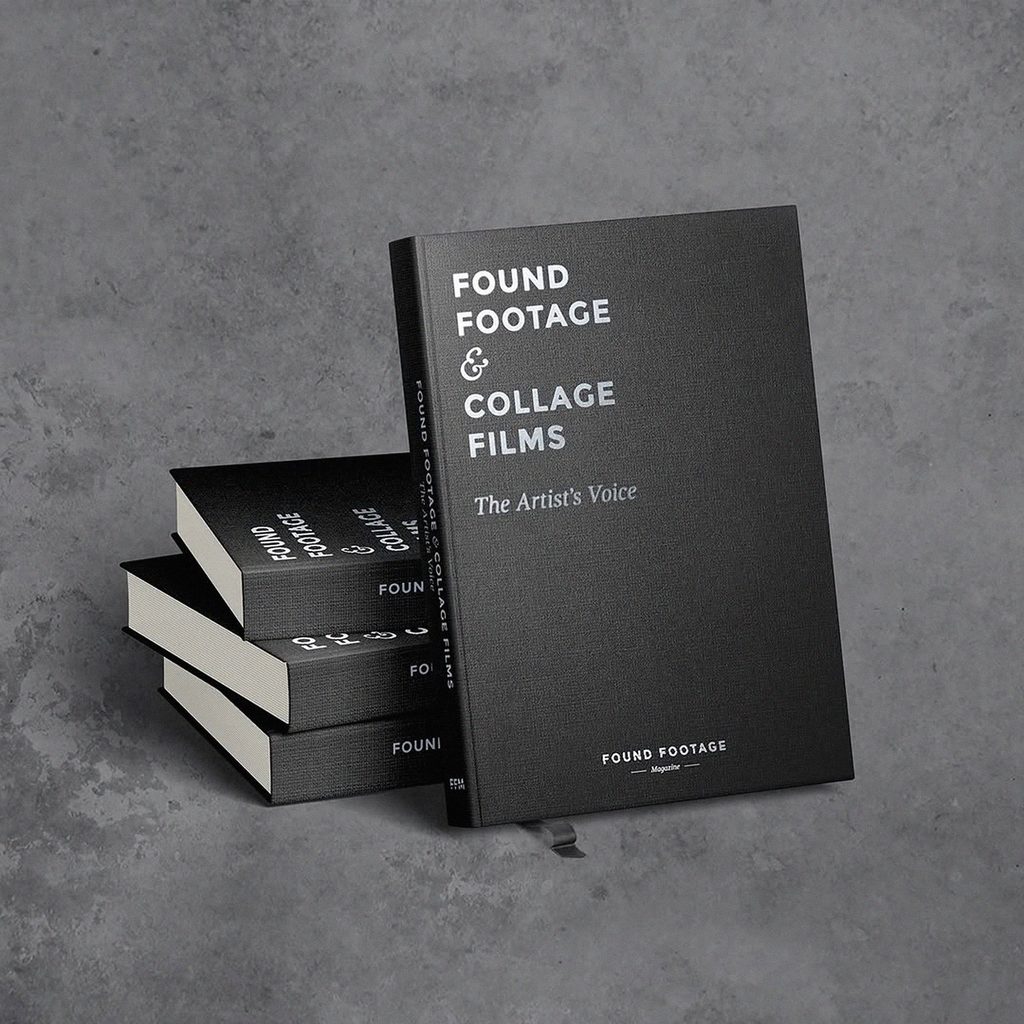
Found Footage & Collage Films: The Artist’s Voice
Edited by César Ustarroz
(Found Footage Magazine, 2025), 336 pages.
Found Footage & Collage Film , edited by Found Footage Magazine founder César Ustarroz, is as striking as it is substantial and marks the magazine’s tenth anniversary. Beautifully designed by Cristina Martínez, the book evokes the reverence of a sacred text; and for the devotional, it just might be. It gathers over forty writings from prominent figures—veteran artists whose practices span experimental film, supercuts, video essay, and essay film traditions. As with any anthology, there are notable absences, although many writers are quick to acknowledge their peers. In particular, Peggy Awash reveals a few omissions while offering a concise history of found footage filmmaking. That her piece appears after after the introduction is happenstance as the essays are arranged alphabetically; nevertheless, it establishes a useful historical framework for the essays that follow.
In his introduction to the collection, Ustarroz describes found footage filmmaking practices as guided by a “weaver’s purpose in sewing together a film with images from previous times” (8). Despite Ustarroz’s evocation of the weaver’s hand, the book’s alphabetical arrangement suggests a different approach, one that makes it unlikely that anyone beyond a fanatic will approach it sequentially. Instead, this format encourages random encounters and serendipitous juxtaposition, where I assume many will begin with familiar names and stumble upon other writers along the way. With this criticism, I still see the collection as fulfilling its aim to present “confessions, motivations, and convictions in slow motion—unique impressions tempered by lived experience” (10). Moreover, the contributors are impressively international and the book is the result of an editor who honours the artist’s voice.
Abigail Child suggests found footage is a form of cultural DNA, “a cultural history, a cultural epigenetics even as it is a cultural critique” (41). Mike Hoolboom extends this DNA metaphor by stretching Blaine Allan’s concept of “parent footage” (145).1 Hoolboom employs a Freudian approach to examine the memories, ideologies, and bias of our parental inheritance, the psychological rough cut from which we’re all assembled. Similarly, Matthias Müller also turns his attention inward to the emotional and psychological drives behind collecting and reworking found images. He asks, “What void is supposedly being filled here by a myriad of images, which trauma obscured by find after find? Is the motor the longing to simply lose oneself? Or possibly to find oneself in these fleeting moments?” (233). His questions suggest that the act of reassembling found material is a form of self-inquiry—an effort to navigate identity through dense layers of contemporary visual culture.
Alberte Pagán offers a more materialist analogy: “found footage is an existing manufactured product, transformed back into raw material” (239). While he goes on to call the term found footage “defective” (240), the practice of using borrowed/stolen/found/expropriated/recycled/repurposed/displaced/salvaged/appropriated/cannibalized/displaced/détourned images remains quite active. Others frame it less as recycling and more as translation. Keith Sanborn likens it to “the process of translation from one language to another” (274). Jayce Salloum poses a polemical but provocative question, asking “isn’t all footage found once it enters the lens and is spit out of the camera?” (266). We can push this concept further suggesting that the cameraperson found the composition, the moment in time, and the time required to create the image.
Soda Jerk’s piece is both humorous and poignant, and will likely find a permanent place on many undergraduate media studies syllabi that address contemporary experimental cinema practices. They suggest that those working in the lineage of Jonas Mekas have lost, lost, lost, while mega-corporations and right-wing meme warriors—who now employ the techniques and philosophies pioneered by found footage artists—have won, won, won. Their central question is urgent: how is it rebellious to “steal images” when corporations like Google and OpenAI operate under the assumption that everything on the internet is fair game for commodification? Compare the relatively small audiences of most found footage films which circulate through microcinemas, galleries and film festivals, with the vast, networked reach of Trump memes that are crafted from appropriated materials and disseminated across online platforms. Meme creators are rarely asked the question that inevitably arises at underground screenings: “Did you get permission to use these images?”
The most powerful essays in the book are by artists directly confronting the politics of found footage filmmaking. While many contributors see themselves as aesthetic outlaws or image thieves, it seems clear that the use of found footage is no longer inherently subversive. As such, the politics seemingly lies in act of reclamation and recontextualization. As Su Friedrich writes, “That’s one of the wonderful (and dangerous?) things about using found footage: context is everything” (102).
Echoing this point, Pagán argues that “images mean nothing because they can mean anything, one thing and the opposite: only context can limit and define their meaning” (240). However, Soda Jerk complicate this further, arguing that “images are not just representations of pre-existing conditions; they’re wildly complex semiotic terrains that condition perpetual, affective and behavioural responses” (293). While meanings may shift, images carry a residual force buried within them. Rania Stephan reinforces this with a poetic insight: “we watch these archival images with memories of their past viewings. These two temporalities are superimposed in the present” (301). Found footage carries within them affective histories which are placed into a new context.
Recontextualizing is a way of challenging the oppressive power structures and past violence hidden within the archives themselves. As Jyoti Mistry explains:
Recontextualization arguably is a procedure of unarchiving—if the characteristic of archives is inherently one of violence in which power affirms the rule of law. Working against the grain of these procedures is an opportunity to confront the historical violence inflicted and experienced. More significantly, it becomes the occasion to remember (the violence and its consequences) (218).
Consider Kamal Aljafari’s A Fidai Film (2024), constructed from archival material housed in Israeli institutions—footage seized from Palestinian archives during the 1982 invasion of Beirut. Aljafari sees the project as “sabotaging the colonial gaze,” (27) reclaiming not just the images, but the power over one’s own histories. Hoolboom, riffing on author Marcus Boon’s In Praise of Copying, reminds us that “most of what we call history is arguably the history of appropriation, and the history of one group stealing from another group” (147). Mike Hoolboom, riffing on Canadian author Marcus Boon’s In Praise of Copying, reminds us that “most of what we call history is arguably the history of appropriation, and the history of one group stealing from another group” (147). But with this radical potential comes real ethical complexity. As Richard Misek cautions, “all forms of found footage filmmaking and artistic appropriation are by their nature interventions into the institution of property” (209). He warns that artists must remain vigilant to ensure that their work doesn’t replicate the same extractive logic that underpins capitalist appropriation.
This tension between radical reuse and ethical responsibility becomes even more pronounced when we consider emerging technologies. As new tools reshape the boundaries of authorship and appropriation, the politics of found footage take on new urgency. One of the only essays to deal directly with AI comes from Keith Sanborn, who ironically refers to it as an “obligatory reference” (279). While it’s still being debated just how obligatory AI truly is to the context of found footage filmmaking, Sanborn’s brief engagement with the topic highlights how the perspectives in this book will remain relevant to evolving media practices. Despite the potential threats posed by AI, Sanborn remains cautiously optimistic, reinforcing the democratizing spirit of found footage by suggesting that these new tools will soon be available to creators without “specialist knowledge or excessively expensive hardware” (280). His view aligns with the book’s broader ethos: that media reuse, in all its forms, should remain open, accessible, and subversive—even in the face of rapidly shifting technological landscapes. Granted this discussion warrants more than just a paragraph, but it gestures toward how the ideas in this collection may continue to resonate in future conversations about authorship and appropriation in a post-AI media landscape.
This volume addresses a readership that extends beyond academia while simultaneously providing primary sources for scholars of experimental cinema. Although it is possible to find a couple of Jacques Derrida citations and at least one cameo by Jacques Rancière, there’s a merciful absence of endnotes. In this way, the collection exemplifies what many contributors describe as the inherently democratizing ethos of found footage: meaningful engagement with the images that saturate contemporary life requires neither academic training nor substantial financial resources.
The book includes texts by the following artists:
Peggy Ahwesh • Kamal Aljafari • Louise Bourque • Abigail Child • Michelle Citron • Peter Delpeut • Susana de Sousa Dias • Daniel Eisenberg • Cécile Fontaine • Su Friedrich • Ernie Gehr • Yervant Gianikian & Angela Ricci Lucchi • Masha Godovannaya • Eve Heller • Philip Hoffman • Mike Hoolboom • Radu Jude • Kevin B. Lee • Malcolm Le Grice • David Leister • Péter Lichter • Leandro Listorti • Jesse McLean • Richard Misek • Jyoti Mistry • Bill Morrison • Matthias Müller • Alberte Pagán • Miranda Pennell • Mark Rappaport • Jayce Salloum • Keith Sanborn • Sylvia Schedelbauer • Soda Jerk • Rania Stephan • Mika Taanila • Fiona Tan • Peter Tscherkassky • Chuck Workman
- Hoolboom attributes the phrase to William Wees but it was more likely coined by Blaine Allan in “David Rimmer’s Surfacing on the Thames,” Cine-Tracts, no. 9 (Winter 1980): 56-61. [↩]