Ordinary Matter [Predux] | Collaboration with Michael Zryd | 2026 | 16mm->AI->DV | 35:58
Synopsis
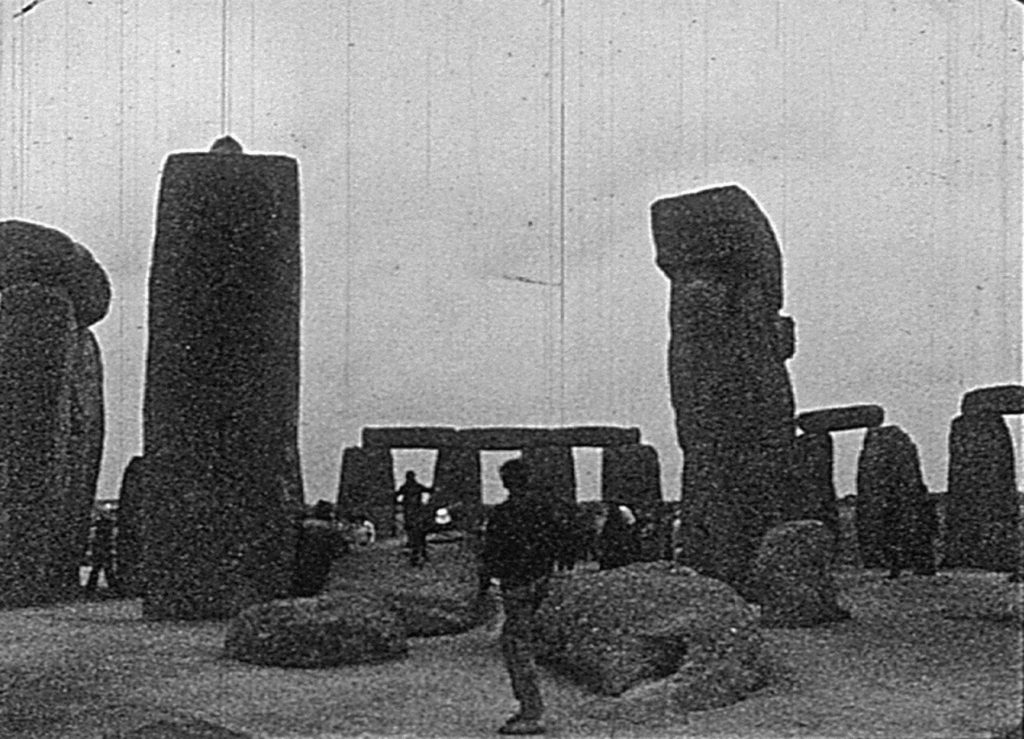
In an act of speculative intervention and within the conceptual art practice of the instruction piece, we have fabricated a version of Frampton’s imagined soundtrack for Ordinary Matter (1972). It is not our desire to restore or recover an “original” artistic intention, but to explore and extend Frampton’s thematic preoccupations with language, gender, and the multidimensional complexities of visual perception. Our work, Ordinary Matter [Predux], employs twelve distinct “gendered” AI-generated voices (including a deepfake of Frampton’s own voice) to read twelve published descriptions of Duchamp’s Étant Donnés: 1. la chute d’eau, 2. le gaz d’éclairage (1946–66). For the visuals, we have applied AI image enhancement to a lo-fi version of the work, producing an effect where the images appear to morph into each other. This transformation is particularly striking given that Frampton’s original 16mm film incorporated pixelation.
Displaced Authorship: Deepfaking Hollis Frampton’s Ordinary Matter [Artist Statement]
In a 1972 interview conducted by Peter Gidal, experimental filmmaker Hollis Frampton discussed a potential soundtrack for his film Ordinary Matter (1972). This soundtrack was to feature twelve twelve-sentence descriptions of Marcel Duchamp’s Étant Donnés: 1. la chute d’eau, 2. le gaz d’éclairage (1946–66) which were motivated in part by the prohibition on reproducing images of the installation. The descriptions were to be gendered, six written by men and six by women, but Frampton proposed an inversion whereby women would read the men’s descriptions, and vice versa, with sentences alternating by gender to create a rhythmic interplay on the soundtrack. In the final version of the film, however, Frampton abandoned this concept instead recording himself reading the Wade-Giles syllabary of Mandarin Chinese without intonation.
We view this as an attempt to posthumously collaborate with Frampton. We are using AI to generated the voices including Frampton’s voice (with the permission of his estate). We present the original proposed soundtrack for Frampton’s film Ordinary Matter (1972), in what might be viewed as an act of speculative intervention. Within the conceptual art practice of the instruction piece, we have fabricated a version of Frampton’s imagined soundtrack for Ordinary Matter—not to restore or recover an “original” artistic intention, but to explore and extend Frampton’s thematic preoccupations with language, gender, and the multidimensional complexities of visual perception. Our work, Ordinary Matter [Predux], employs twelve distinct “gendered” AI-generated voices—including a deepfake of Frampton’s own voice—to read twelve published descriptions of Duchamp’s Étant Donnés. For the visuals, we have applied AI image enhancement to a lo-fi version of the work, producing an effect where the images appear to morph into each other. This transformation is particularly striking given that Frampton’s original 16mm film incorporated pixelation.
Let us begin with some context. Frampton was, like many artists in the emerging New York art scene of the 1960s, highly influenced by Marcel Duchamp. Frampton mentions Duchamp in many letters, interviews, and essays, in addition to directly invoking Duchamp’s work in several film and art projects. These include several films Cadenza I (1977-80), which plays off the scenario suggested in the title of Duchamp’s The Bride Stripped Bare By Her Bachelors, Even (1923). In More Than Meets the Eye (1979), the film includes spiral text akin to Duchamp’s only film, Anemic Cinema (1926) but adds fish-eye lens footage of the Scrambler fairground ride. Duchamp’s work is also central to two incomplete projects: In a 1964 letter to Reno Odlin, he describes an installation version of Clouds of Magellan that intended to mimic The Green Box (1934); Magellan eventually became the planned thirty-six-hour calendrical film cycle that was left incomplete at Frampton’s premature death from cancer age forty-eight. Today, I focus on a planned soundtrack for the film Ordinary Matter (1972), which is part five of the seven part serial work Hapax Legomena (1971-72), which plays off Étant Donnés (1946-66). Hapax Legomena is a Latin expression for ‘things said once’ and, although fifth in the series, Ordinary Matter was the final film to be produced.
As late as May 1972, when Frampton screened six of the films at the London Film Co-op in the UK, he proposed the following plan for the soundtrack in an interview with filmmaker and theorist Peter Gidal:
HF: To begin with, there is an object in Philadelphia, a posthumously constructed object by Marcel Duchamp, called Given: (1) the waterfall, (2) the illuminating gas. I think I need not describe that here; suffice it to say that it is not only impossible, in the mode of the construction of the thing, but also illegal, in the terms of Duchamp’s testament, to photograph the thing. One has had, therefore, to get by with verbal description of it. And I began to notice that no two people describe it in the same way. Well, so far we have six blind men and their elephant. But of particular interest is the fact that everyone who has described it has left something out.
PG: Please describe it.
HF: Okay. I’ll describe it: You walk up to a pair of big double doors, very weatherbeaten, heavy, scratched timber doors; they look like the entrance to a medieval speakeasy. What does this all mean anyway? Marcel does it again! You know, the work keeps nibbling at my mind with very profound suggestions of cinema, particularly the curious enigma that the frame…
PG: Yes, the frame as cutoff …
HF: The frame as a strange model, both negative and positive, for human consciousness … just the frame itself. I’m now working on putting together twelve descriptions of twelve sentences each—that’s 144 sentences of plain description—of this object from various people. Six descriptions will be written by men and six by women. They will be read again, aloud in the following manner: all the number one sentences will be followed by all the number two sentences, followed by all the number three. They will be read by two voices, a man’s voice and a woman’s voice, with the roles exchanged. The descriptions written by women will be read by a male voice and vice versa. That’s the whole substance of the thing.
Frampton also describes the image, part of which is realized in the film:
HF: There will also be an image which will consist of a more or less continuous time lapse journey, a dolly from Stonehenge on Salisbury Plain to the kitchen of my farmhouse in central New York state via a number of other landmarks. I’m shooting the whole thing on grainy stock, 4x reversal, and it’ll be printed in high contrast. What will happen, of course, is that there will be a very jerky frame: one frame every four or five feet or so when there’s walking. Also, shots from an automobile. Velocity carried through a landscape.
The main way the final version of the film diverges from this plan is the following:
HF: There will be a hold or freeze frame in the image for each word in the soundtrack. For short words perhaps no more than three frames or so; for longer words, four or five. I regret in anticipation that this film is going to be made. I haven’t entirely taken the path that leads to getting the most fun out of life in that respect.
List of Texts
- John Canaday, “Philadelphia Museum Shows Final Duchamp Work,” New York Times (July 7, 1969).
- Anne D’Harnoncourt and Walter Hopps, Etant Donnes : 1 La Chute d’eau, 2 Le Gas d’eclairage : Reflections on a New Work by Marcel Duchamp (Philadelphia Museum of Art, 1969).
- Anonymous, “Artists: Peep Show,” Time (July 11, 1969).
- Barbara Gold, “Art Notes: Duchamp Explodes a Myth,” Baltimore Sun (July 27, 1969).
- Hollis Frampton, “Peter Gidal Interview with Hollis Frampton [1972], ” in Hollis Frampton, edited by Michael Zryd (MIT Press, 2022).
- Joan Messenger, Marcel Duchamp: Alchemical Symbolism in and Relationships Between the Large Glass and the Étant Donnés (MA Thesis, California State University, 1977).
- Octavio Paz, “Water Writes Always in Plural,” Diacritics 8.4 (1978).
- Molly Nesbit, “Marcel Duchamp’s Étant Donnés,” Artform 32.1 (September 1993).
- Stanley Meisler, “The enigmatic Étant Donnés,” LA Times (September 27, 2009).
- Ernestine Daubner, “Etant Donnés: Rrose/Duchamp in a Mirror,” RACAR 22.1-2 (1995).
- Julian Jason Haladyn, Marcel Duchamp: Étant Donnés (Afterall Books/MIT Press, 2010).
- Caroline Cros, Marcel Duchamp, translated by Vivian Rehberg (Reaktion, 2006).
Work Details
- We use twelve descriptions from art criticism which Mike compiled. He took the passages that seemed most “descriptive” and arranged them into a script. Ideally, we would have liked to have twelve, twelve sentence descriptions of the work, but in reality, they all varied in length and even Frampton’s description was thirteen sentences. In the end, we obtained 144 sentences in total, with voices dropping out once they had run of text.
- We used eleven “gendered” and one “non-gendered” AI generated text-to-voice in order to synthesize the soundtrack. The voices were generated using ElevenLabs Generative Voice AI. To produce a clone of Frampton’s voice, I used Frampton’s Screening Room interview with Robert Gardner to obtain a 30-minute sample of his voice. The AI-generated voices have a wide range of accents (the French accent is a bit of a joke given Caroline Cros’ book was translated from French).
- We are aware that Frampton’s plan presumes a gender binary (it goes without saying that Frampton is symptomatic of his time) and there’s much research on Duchamp and gender. On one hand, Frampton was better than most experimental filmmakers in engaging with emergent feminist film theory and artists—i.e. not a sexist pig. On the other hand, he was largely symptomatic of his time, with straight white male privilege and whiffs of homophobia in evidence.
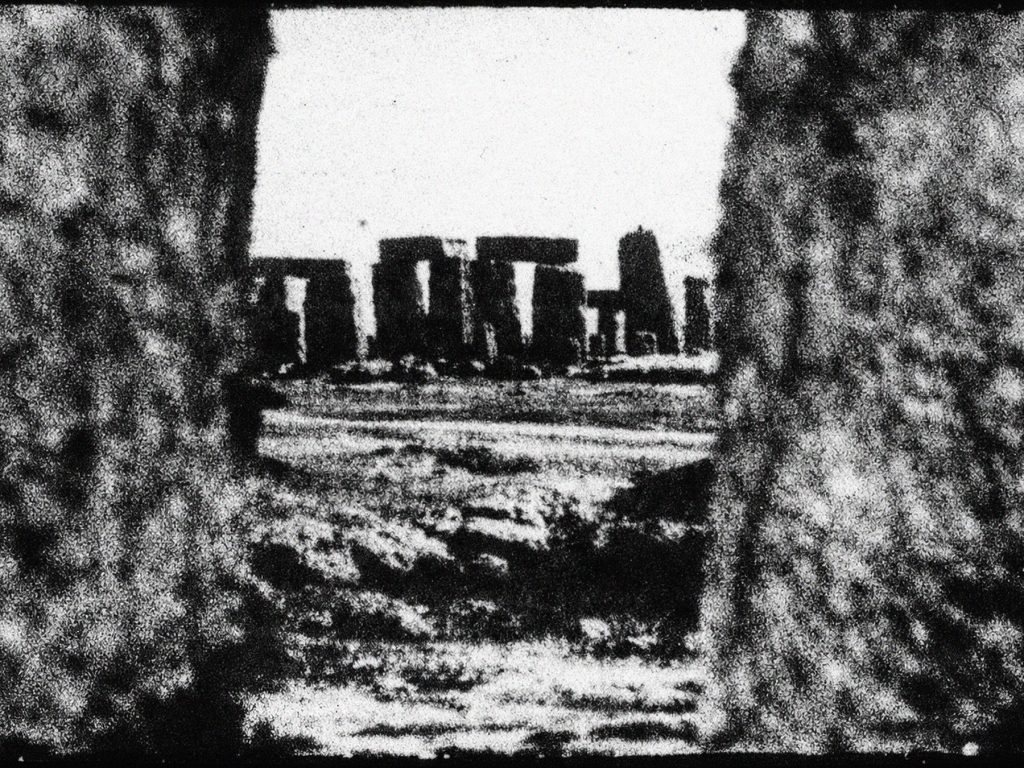
- The images for our version came from a bootleg DVD of the work, which I suspect came from a digitized telecine scan of Frampton’s 16mm film originally recorded to Betacam. I used Topaz AI to clean up the images and ran the piece through a filter which mimicked the grain structure, contrast, and tonal range of Kodak Tri-X Reversal Film 7266.
Through this reimagining, our artwork interrogates numerous questions, particularly surrounding the use of AI in creative practices. For example, what constitutes appropriate boundaries for artistic appropriation and conceptual reimagining? What ethical considerations and best practices should be established for employing deepfakes in art? Is it sufficient to disclose the presence of an AI-generated voice, or does the context of its use demand further scrutiny? What does it mean for an AI-generated voice to be “gendered,” and how might this complicate the ways we think about identity and performance?
The question of AI and “gender” must be situated within the larger discursive and technological apparatuses that shape our interactions with so-called intelligent systems. It is hardly incidental that AI assistants—Siri (Apple), Alexa (Amazon), Cortana (Microsoft), and Google Assistant—have historically defaulted to feminized voices and personae. As digital media theorists Pedro Costa and Luísa Ribas point out, these assistants no longer function simply as tools; they are positioned as “friendly companions,” mediating not just informational labor but also affective and emotional terrains traditionally associated with feminized domesticity. This deployment of a feminized interface is not an arbitrary design decision but rather a material instantiation of long-standing gender binaries, a computational performance of femininity encoded through tone, cadence, and compliance.
Costa and Ribas identify the critical dynamic at play: these assistants do not merely perform tasks; they perform gender, reproducing affective and social codes that reflect normative cultural expectations. This feminization of labor, as processed through digital interfaces, re-inscribes the ideological division of labor—what Silvia Federici would call the unpaid, invisible work of emotional caretaking—now automated and aestheticized within the framework of corporate design.
As artists and scholars committed to experimental media practices, we interrogate these logics through both aesthetic resistance and speculative design. By experimenting with a variety of AI-generated voices—ranging from traditionally gendered to deliberately ambiguous or androgynous—we attempt to de-naturalize the assumed gendered affordances of AI speech synthesis. Our artistic process thus becomes one of hijacking corporate tools and re-routing them toward critical engagements with identity, language, and technology.
In parallel, we have undertaken an ethically fraught but conceptually rich gesture: the attempt to recreate the voice of Hollis Frampton using deepfake audio technologies. According to Adrienne de Ruiter, deepfakes are not inherently morally wrong, but their ethical status hinges on three central considerations: the consent of the person deepfaked, the degree of deception involved, and the creator’s intent. These parameters, while useful, do not always map cleanly onto the experimental domain of art, where ambiguity and critical provocation are often central to the work’s aesthetic and political function.
To engage these concerns head-on:
- Consent, in this case, is murky. Frampton is no longer alive, and therefore cannot authorize or object to this reanimation. While we cannot presume his approval, we have reached out to his estate to seek retrospective permission. Nevertheless, even with permission from his estate this gesture remains speculative—an ethics of the hypothetical.
- Our intent is not to deceive, but to disclose. The artificiality of the voice is not concealed; it is highlighted as part of the work’s critical infrastructure. The point is not to make Frampton speak again but to foreground the possibilities inherent in making him speak through AI. It is our desire that the voice “sounds real,” but what does “real” mean at this point in time?
- Ordinary Matter [Predux] is a reactivation, a deliberate staging of Frampton’s preoccupations with language, perception, and media. Should the work “fail;” it is Frampton’s failure, but ours.
Through the work we are attempting to converse with Frampton’s legacy—across temporal, ontological, and technological thresholds. The project is driven by a sincere intellectual and artistic investment in his work, as evidenced by the extensive scholarly and creative labor we have dedicated to his oeuvre. If this experiment courts controversy, it is not from a place of exploitation, but from a desire to ask urgent questions within the context of artistic appropriation and within the artistic uses of AI.