[ pink noise ] | 2025 | SRT -> HD | 10:37
Synopsis
A cinematic text. An anti-immersive experience. An inner odyssey.
Critical Discourse
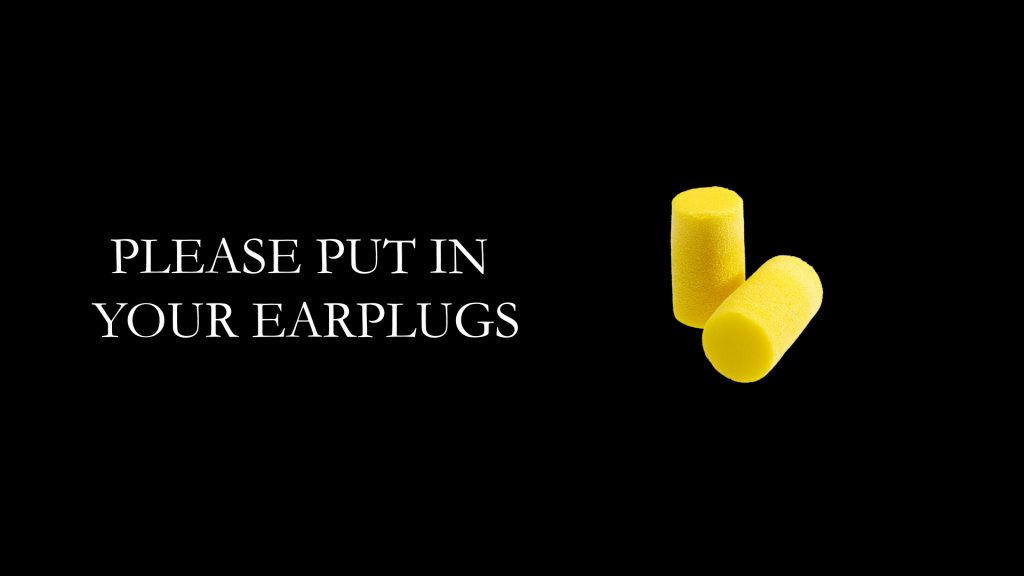
“Enns’ film is a conceptual piece, but unlike many such works, the concept continues unfolding over the course of the screening and for quite some time afterward. This is a silent film, and Enns begins with his own version of the “Put on 3D glasses now” card, prescribing the insertion of earplugs. [pink noise] is essentially a black field with subtitles, almost all of which allude to some unheard noise. It’s clear Enns is referencing captioning for the hearing impaired, but on occasion he slips in some apparent dialog which, again, does not exist in the film. Intellectually, [pink noise] is a distant cousin to Michael Snow’s So Is This, in the sense that language that is typically a supplement or substitute for cinematic meaning is displayed as the meaning itself. By extension, [pink noise] operates just inside the boundaries of what can be considered a film. Nice work.” – Michael Sicinksi, “Ten Selections from Light Matter 2025” Obscure Alternatives (November 24, 2025).
“In my day job as a college writing instructor, there is a lot of talk about “multi-modal composition.” This simply means that instead of remaining strictly within the bounds of the written argumentative essay, students are often encouraged to employ digital media to produce audiovisual argumentation. This can take many forms, including PowerPoint, annotated slide shows, or essay films that bolster the main argument with moving or still images and even a soundtrack. Multi-modal writing is a logical outgrowth of desktop media production, and it is often encouraged as a way to get students to think about the different kinds of material that can count as evidence.
In viewing the films in the 2026 edition of Toronto’s Images Festival, I found myself thinking about this a lot. Many of the films in this year’s selection would receive an A+ in a writing course, since they are primarily driven by clear, cogent verbal or written arguments. In many cases, the sounds and images are fully subordinate to the filmmakers’ use of language. According to an older set of criteria, these films are not always satisfying as works of art. Instead of bringing together text, audio, and visual materials to comment on each other or to create productive ambiguity, many of these works use the text to explain exactly what it is we are seeing and hearing. Thus, the actual filmmaking can sometimes feel illustrative of a point that is being made elsewhere.
In his 1964 essay “The Rhetoric of the Image,” Roland Barthes (who has a cameo of sorts in one of the festival’s films, Dayna McLeod’s FoUBARthes: Death of the Author) argued that the relationship between text and image tends to fall into two categories. “Anchorage” is when the text captions an image. It is designed to foreclose the polysemous capacities of an image, making sure the reader knows exactly what the image is supposed to mean. “Relay,” the other function, occurs when text and image are mutually defining a third term, which is some kind of narrative meaning. In both cases, the author does not permit the reader infinite freedom of interpretation. There is a preferred meaning that the image is there to facilitate.
In a lot of newer media work, one sees this playing out, and this means that the unique communicative possibilities of the image are in danger of being severely limited. One almost always gets the feeling that the text came first, giving these works the appearance of an illustrated essay. In many cases, no doubt, the creator was working with the images and figured out what they wanted to say about them based on that encounter. But this kind of filmmaking has the curious effect of making the text feel primary, even if the writing of said text was a direct result of the filmmaker having engaged with the images we’re seeing. This may be because most of us have greater facility with analyzing words than images, with sound representing an even more obscure venue for meaning. However, this awareness that language tends to supplant image and sound ought to be taken into account, resulting in a practice that prioritizes imagery and sound, all the better to compensate for our lopsided understanding.
A very good example of a film that critically engages with this situation is [pink noise] by Clint Enns. This is a silent, almost imageless film, comprised of a disconnected series of subtitles shown on a black screen. Enns is referring not only to conventional subtitling practice, but more specifically to the .srt files that accompany digital cinema files. Enns’ titles describe obscure sounds we are not hearing, and while they often hint at some kind of narrative cohesion, they never coalesce into a clear meaning. [pink noise] alludes to subtitles as an anchorage text by presenting them in the absence of any images or sounds to anchor. It also engages with the material specifics of watching a film online, something one probably notices even more strongly when seeing it in a theater.” – Michael Sicinksi, “Anchor & Flow: The 2026 Images Festival,” In Review Online (April 15, 2026).
Screenings/Exhibitions
July 29, 2026. Ex-Now, EXIS, Korea Film Archive Cinematheque, Seoul, Korea.
April 10, 2026. Unstill Image, Images Festival, Toronto, Ontario. Curated by Alper Turan.
October 16, 2025. Magic with Small Apparatus, Antimatter, Victoria, British Columbia.
November 7, 2025. PersonalEyes, Light Matters Film Festival, Nevins Theater, Alfred, New York. Curated by James Hansen.